 CHASE TERRY
Interactive projected light
God's Eye
also known as Living Mandala
Draw anything on an iPad. The system takes your drawing, kaleidoscopes it, and throws it across the room at projector scale — while you keep bending it with buttons and sliders. Your doodle becomes architecture, and then it becomes something else.
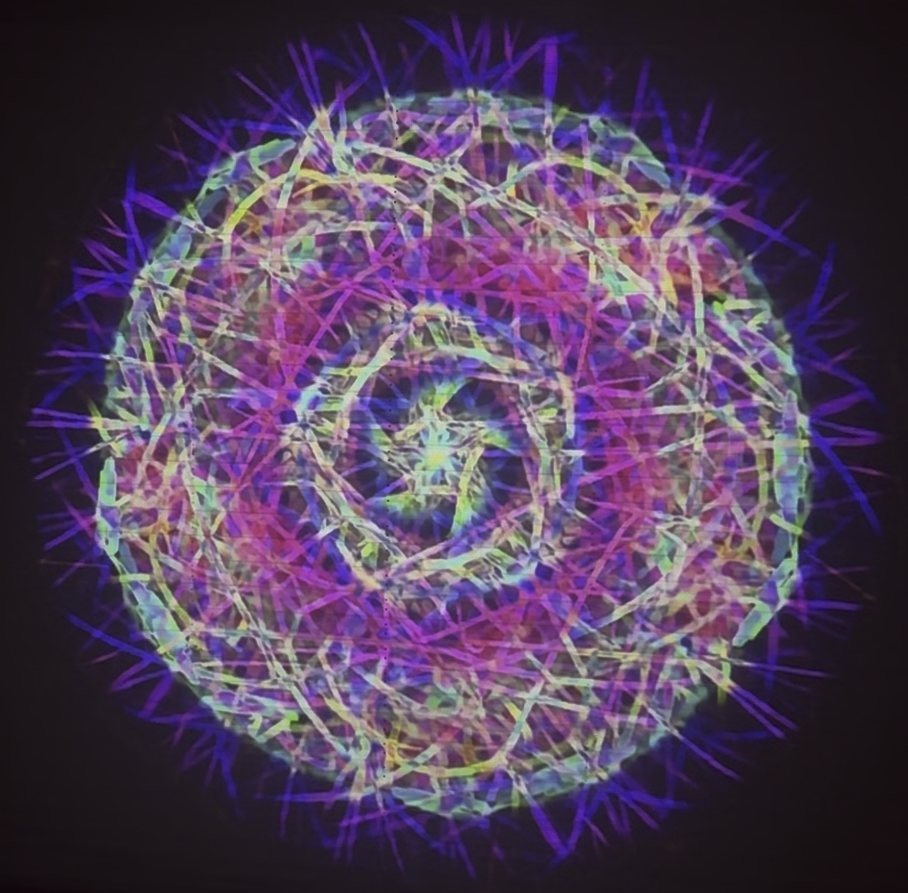
See it run
How it works
iPad → kaleidoscope → wallYou draw
Anything. A line, a name, a face, a shape you don't have a word for. No skill required and no wrong answer — the transform is generous to bad drawings and unkind to careful ones.
It kaleidoscopes
The drawing is mirrored and rotated around a center until it closes into a mandala. What was a scribble becomes symmetrical, enormous, and oddly deliberate.
It fills the room
Out to the projector at wall scale, live. The gap between your finger moving and the room changing is short enough that people keep drawing to see what happens.
Then you play with it
The drawing is the input, not the output. A panel of buttons and sliders sits next to the canvas, and everything on it is live — change, augment, refract. Most people come for the drawing and stay for the controls.
- Change — segment count, rotation, scale and speed. Six-fold reads as a snowflake; twenty-four-fold reads as a cathedral window.
- Augment — colour, bloom, trails and layering, so the mandala keeps moving after your hand stops.
- Refract — feedback and displacement that fold the image back through itself. This is where it stops looking like your drawing and starts looking like something that was always there.
Stills
[ADD 6]A before-and-after pair
Bring it to a room
God's Eye works where people have time to stand still: galleries, parties, festival chill spaces, lobbies, weddings, launches. It needs a dark-ish wall and about 10-30 feet of throw — it does not need a stage.
It runs as an attended piece, meaning I'm there operating and resetting it, which is also what keeps it interesting for a crowd rather than a loop playing to nobody.